
How Long Does a Home Solar Battery Last? Lifespan, Warranties and Capacity Explained
How battery life is measured, what wears a battery, and how to read a warranty (updated November 2026)
Jump to
A home battery is a big purchase, so it's fair to ask how long it will last. There's no single number: battery life is described in several ways, depends on use and installation, and the warranty tells only part of the story.
The short answer
energy.gov.au says many battery manufacturers offer a 10-year product warranty, which it links to the average life of a battery. Terms can be shorter depending on the battery type, its capacity and how it is used [1][2].
Solar Victoria says a battery can outlast what its warranty suggests, as long as it was sized correctly and is cycled within the depth and frequency it is rated for [3]. That isn't a promise, so it's worth knowing what your warranty covers.
How battery life is described
energy.gov.au says a battery's expected lifetime can be measured in [1]:
- Years: a fixed term, such as 10 years.
- Cycles: how many times it is charged and discharged.
- Throughput: the total energy it is expected to store and deliver over its life.
Warranties often add retained capacity: a promise that the battery will still hold a stated share of its original capacity at the end of the warranty. energy.gov.au gives the example of 60% of original capacity for 10 years [2].
Also check whether a figure refers to usable capacity. Batteries can't be fully emptied, so usable capacity is less than total capacity [1].
What wears a battery down
- Cycling. Lifespan is influenced by the number of cycles [3].
- Depth of discharge. Some warranties assume cycling to a set depth of discharge (DoD). Going beyond it may affect the warranty or lifespan [3].
- Heat. Solar Victoria notes a battery can be placed somewhere cool to help maximise its lifespan [3].
- Sizing. Correct sizing is one of the conditions Solar Victoria links to a longer life [3]. See what size solar battery you need.
How to read a battery warranty
Some warranties set conditions of use, so check these before you choose [2][4].
| Warranty term | What to check |
|---|---|
| Term | How many years the product warranty runs [2] |
| Retained capacity | The share of original capacity promised at the end [2] |
| Cycles or throughput | Whether the warranty ends early once a cycle or throughput limit is reached [2] |
| Conditions of use | Daily cycling limits, whether grid charging is allowed, weather exposure, location and temperature range [2][4] |
| Inverter | Battery and hybrid inverters may have a different term [2] |
| Workmanship | Covers installation problems; usually 5 years, says energy.gov.au [2] |
| Responsibility | Which parts the retailer or installer covers, and which the manufacturer covers [1][4] |
Your rights beyond the warranty
A warranty is an extra promise. The Australian Consumer Law also gives you automatic consumer guarantees: products must be of acceptable quality, and installation must be done with due care and skill [5].
The ACCC says a warranty can't take these rights away, and the guarantee of acceptable quality usually still applies after a warranty ends [6]. Consumer guarantees last for a reasonable time, depending on things like what the product is, what it cost and how it would normally be used. This may be longer than the warranty [7].
Looking after your battery

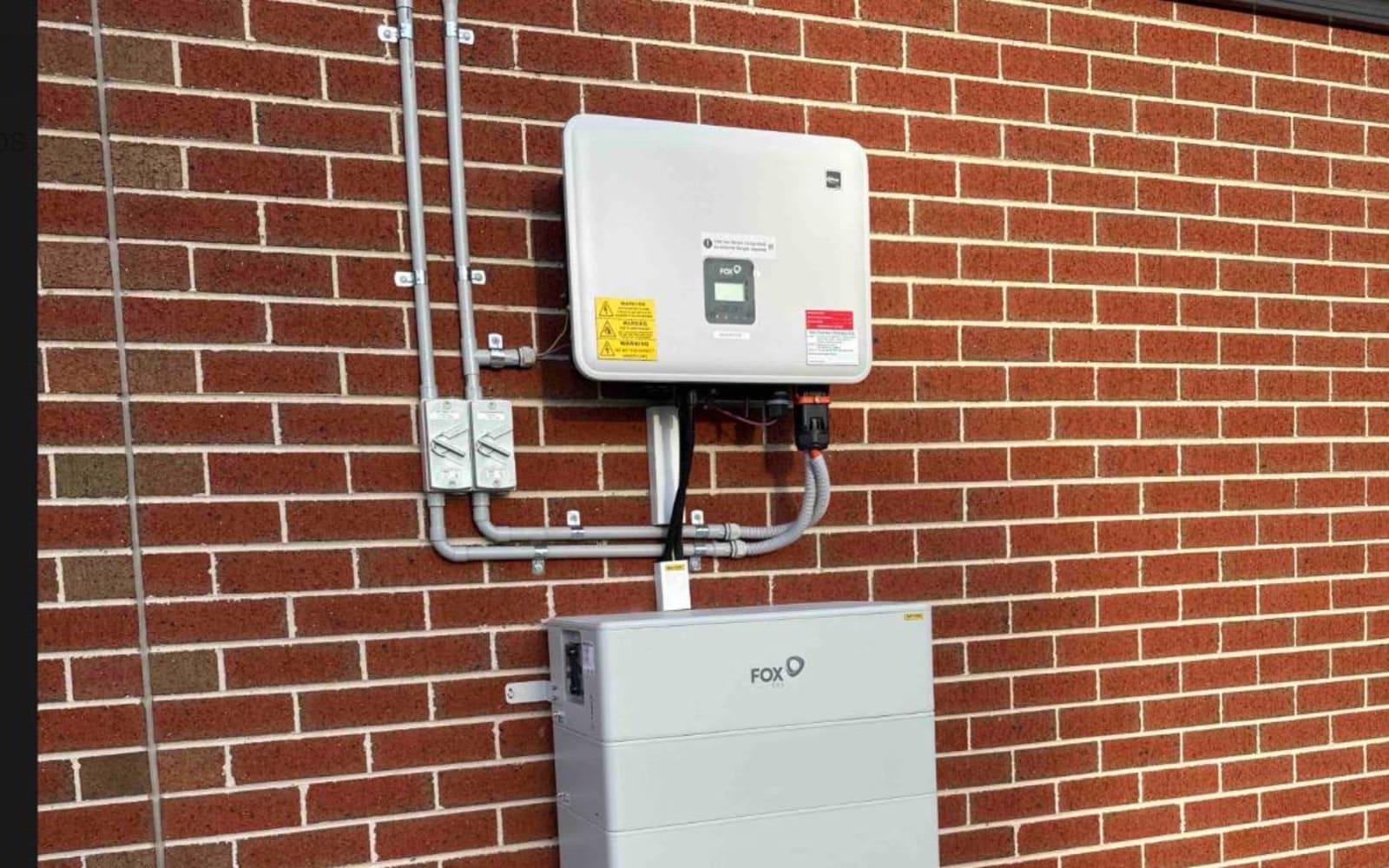
A home battery installation by Amos Green Energy.
- Location. There are rules on the wall a battery is mounted on and distances from living areas, doors and windows [1]. Ask whether the spot meets the manufacturer's requirements [4].
- Monitoring. Ask how you'll see performance data; some batteries need internet for this [1][4].
- Warranty conditions. Follow any conditions of use, and ask whether maintenance is needed and who does it [2][4].
- Paperwork. Keep the written documentation about your battery and installation [8].
If you're adding a battery to existing solar, ask how it affects your current warranties.
Cheaper Home Batteries Program (as at 5 November 2026)
As at 5 November 2026, the federal Cheaper Home Batteries Program offers a discount of around 30% on the upfront cost of installing an eligible battery [8][9]. The discount per kWh is lower for larger batteries (DCCEEW applies 100% of the certificate factor up to 14 kWh, 60% from 14 to 28 kWh and 15% from 28 to 50 kWh) and depends on the installation date [8][9]. The Clean Energy Regulator says the battery must be on the Clean Energy Council approved list and installed by a Solar Accreditation Australia accredited installer with a battery endorsement, and it should stay at the property for its warranty period or until the end of 2030, whichever is later [8]. Rules change, so check the CER and DCCEEW websites before you sign.
Frequently asked questions
Does a battery stop working when its warranty ends?
Not necessarily. A battery may outlast its warranty when well sized and used within its ratings [3], but its capacity can still decline.
What if my battery fails after the warranty ends?
You may still have rights under the consumer guarantees [6][7]. Contact the business that sold you the battery first.
Final thoughts
Battery life depends on cycling, depth of discharge, temperature, sizing and where it's installed, so read the warranty closely. For whether a battery suits your home, see is a solar battery still worth it in Melbourne?
SourcesShowHide
- [1] energy.gov.au, Batteries (accessed 5 November 2026)
- [2] energy.gov.au, Warranties and insurance (accessed 5 November 2026)
- [3] Solar Victoria, Solar battery buyers guide, section 4: solar battery systems and components (updated 2 October 2025; accessed 5 November 2026)
- [4] Solar Victoria, Solar battery buyers guide, section 7: finding the right retailer and steps to installation (updated 2 October 2025; accessed 5 November 2026)
- [5] ACCC, Solar panel systems and home batteries (accessed 5 November 2026)
- [6] ACCC, Warranties (last updated 28 September 2026; accessed 5 November 2026)
- [7] ACCC, Broken but out of warranty? Your consumer guarantee rights may still apply (18 January 2024; accessed 5 November 2026)
- [8] Clean Energy Regulator, Solar batteries (last updated 29 October 2026; accessed 5 November 2026)
- [9] DCCEEW, Cheaper Home Batteries Program (last updated 9 June 2026; accessed 5 November 2026)
This article is general information only, current as at November 2026. It is not financial or legal advice. Warranty terms vary between products, and program rules can change.